
Basking Ridge Presbyterian Church
1 East Oak St.
Map / Directions to the Basking Ridge Presbyterian Church
Map / Directions to all Basking Ridge Revolutionary War Sites
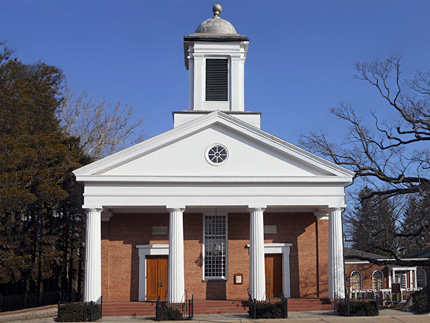
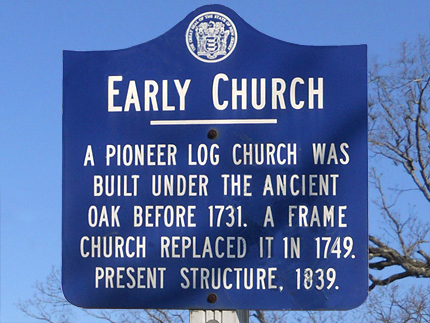
The original Presbyterian Church at this spot was a log church built circa 1717. It was replaced in 1749 by a frame church, which stood here during the time of the Revolutionary War. A company of colonial soldiers drilled on the church grounds in 1775. Many men who belonged to the church's congregation fought in the Revolutionary War. The 1749 church building was torn down in 1839 and replaced on the same site with the brick structure that still stands here today. [1]
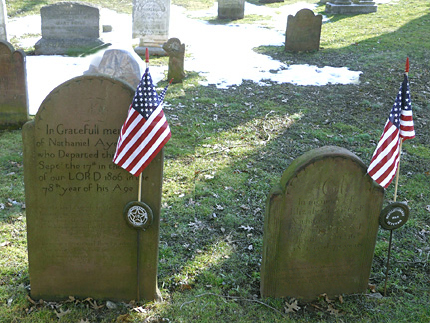
Thirty-five Revolutionary War soldiers are known to be buried in the cemetery: [2]
Benjamin Alward
John Ayres
Nathaniel Ayres
John Baird
George Bockoven
John Boylan
John Brees Sr.
John Brees Jr.
Stephen Brees
John Carle
Jonas Carle
Hugh Colwell
Daniel Doty
William Doughty
James Finley
John Hall
Samuel Johnson
Alexander Kirkpatrick
David Kirkpatrick
James Kirkpatrick
Edward Lewis
Thomas Logan
Gavin McCoy
Jonathan Miller
John Parker
Samuel Reynolds
Israel Rickey
Thomas Riggs
Peter Sharpenstine
David Simpson
Henry Southard
James Thompson
Jonathan Whitaker Sr.
Jonathan Whitaker Jr.
Stafford Wilson
I wrote the following description of this white oak tree in January 2015.
In late 2016, it was determined that the tree had died, and was to be torn down in 2017.
Upon hearing of the sad news of the death of this tree, I decided to leave my original description of the tree unchanged.
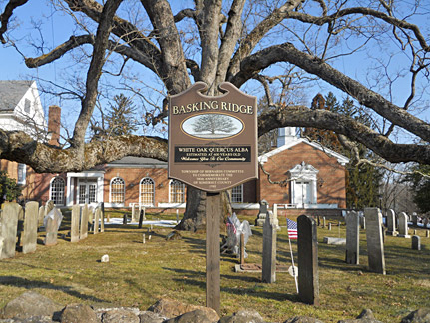
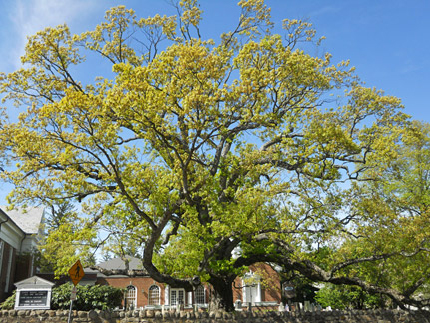
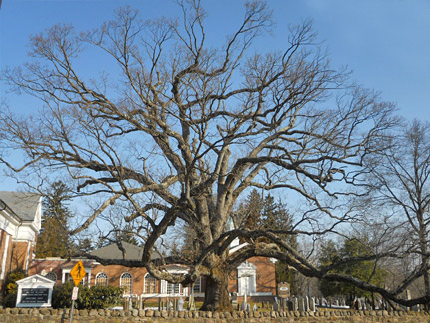
This magnificent white oak tree (Quercus alba) stands in the church cemetery. The tree is approximately 600 years old. It stands about 100 feet high with a spread of over 150 feet. [3] It is pictured to the left in both summer and winter.
The tree was already 350 years old at the time of the Revolutionary War, and so it stood here when the events described on this page occurred. A great deal of Revolutionary War activity occurred in the surrounding area, and an army hospital stood less than a mile from here. (See the Revolutionary War Hospital Site entry lower on this page.) Revolutionary War soldiers must have passed by this tree many times, and likely some of them stopped at it. There is a local tradition that George Washington and the Marquis de Lafayette had a picnic at the tree, but there is no documentation for this.
I have spent many years traveling all over the state for this Revolutionary War New Jersey project, and have visited hundreds of historic locations. Of all the many spots I have visited during the course of the research, I would rate this oak tree as one of my favorites. There is something that inspires awe while standing by this tree and thinking about all of the things that have occurred near it over the course of six centuries. It is also very beautiful.
I highly recommend visiting this spot to see the tree in person!
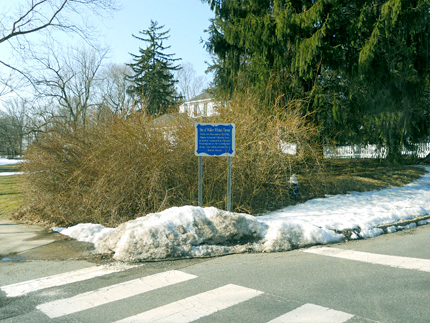
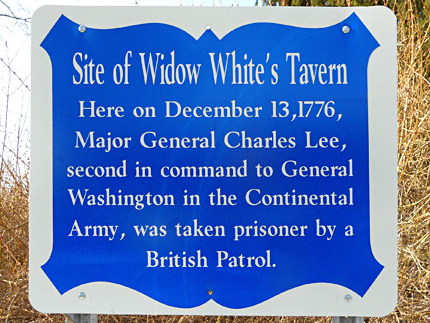
Widow White's Tavern Site
South Finley Ave. and Colonial Dr.
Map / Directions to Widow White's Tavern Site
Map / Directions to all Basking Ridge Revolutionary War Sites
In early December 1776, General George Washington was encamped with the main body of the army on the Pennsylvania side of the Delaware River. It was a desperate time for Washington's army, having spent the previous weeks retreating across New Jersey from Fort Lee, following their defeats in New York.
General Charles Lee, who served under Washington, was at the time headquartered in Peekskill, New York, with 5,000 troops. Washington had repeatedly written to Lee, beseeching him to march with his own troops to join the main body of the army on the Delaware River. Lee, who was disdainful of Washington's leadership and saw himself as better suited for Washington's job as Supreme Commander of the army, evaded the requests, and he offered a list of excuses for not marching to meet with Washington. Washington wrote to Lee in frustration, "I have so frequently mentioned our situation, and the necessity of your aid, that it is painful to me to add a word upon the subject. Let me once more request and entreat you to march immediately." [4]
When General Lee eventually started his troops marching, he reached Basking Ridge, where he stayed at White's Tavern the night of December 12-13. The tavern was located several miles from the main portion of Lee's troops; Lee was accompanied at the tavern only by his aides and approximately twelve guards. The British cavalry discovered Lee's location from several local Loyalists, and on the morning of December 13, a group of British dragoons (cavalry) under twenty-two-year-old officer Banastre Tarleton galloped up to White's Tavern.
The following account of what happened next was written by James Wilkinson, an American officer who was at White's Tavern at the time delivering a letter to General Lee from General Horatio Gates: [5]
"General Lee wasted the morning in altercation with certain militia corps who were of his command, particularly the Connecticut light horse, several of whom appeared in large full-bottomed perukes, and were treated very irreverently; the call of the adjutant general for orders, also occupied some of his time, and we did not sit down to breakfast before 10 o'clock. General Lee was engaged in answering General Gates's letter, and I had risen from the table, and was looking out of an end window, down a lane about one hundred yards in length, which led to the house from the main road, when I discovered a party of British dragoons turn a corner of the avenue at a full charge. Startled at this unexpected spectacle, I exclaimed, 'Here, sir, are the British cavalry.' 'Where?' replied the General, who had signed his letter in the instant. 'Around the house;' for they had opened files, and encompassed the building. General Lee appeared alarmed, yet collected, and his second observation marked his self-possession: 'Where is the guard?—damn the guard, why don't they fire?' And after a momentary pause, he turned to me and said, 'Do, sir, see what has become of the guard.' The women of the house at this moment entered the room, and proposed to him to conceal himself in a bed, which he rejected with evident disgust. I caught up my pistols which lay on the table, thrust the letter he had been writing into my pocket, and passed into a room at the opposite end of the house, where I had seen the guard in the morning. Here I discovered their arms; but the men were absent. I stepped out of the door, and perceived the dragoons chasing them in different directions, and receiving a very uncivil salutation, I returned into the house.
"Too inexperienced immediately to penetrate the motives of this enterprise, I considered the rencontre accidental, and from the terrific tales spread over the country, of the violence and barbarity of the enemy, I believed it to be a wanton murdering party, and determined not to die without company. I accordingly sought a position where I could not be approached by more than one person at a time, and with a pistol in each hand I awaited the expected search, resolved to shoot the first and the second person who might appear, and then to appeal to my sword. I did not remain long in this unpleasant situation, but was apprised of the object of the incursion by the very audible declaration, 'If the General does not surrender in five minutes, I will set fire to the house;' which, after a short pause, was repeated with a solemn oath; and within two minutes I heard it proclaimed, 'Here is the General, he has surrendered.' A general shout ensued, the trumpet sounded the assembly, and the unfortunate Lee, mounted on my horse, which stood ready at the door, was hurried off in triumph, bareheaded, in his slippers and blanket coat, his collar open, and his shirt very much soiled from several days use."
Twelve days after Lee's capture, Washington and his army made their famous Christmas Crossing of the Delaware River to their victory at the first Battle of Trenton. This was followed several days later by the second Battle of Trenton, and the Battle of Princeton.
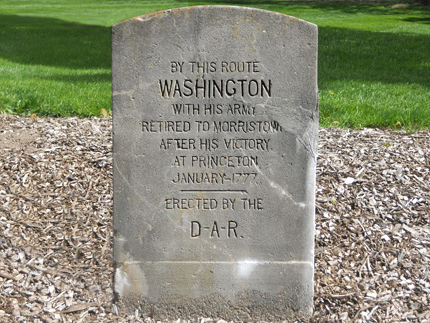
Washington Route Marker
North Maple Rd. and Madisonville Rd.
Map / Directions to the Basking Ridge Washington Route Marker
Map / Directions to all Basking Ridge Revolutionary War Sites
Following their victory at the Battle of Princeton on January 3, 1777, Washington and his army went to Morristown for winter quarters, where they arrived on January 6.
This marker is the tenth of a series of thirteen, showing the route taken by Washington's army from Princeton to Morristown. [6]
The other markers in this series can be found in Princeton, Kingston, Griggstown, Bridgewater, Somerville, Bedminster, Bernardsville, Harding Township and Morris Township.
For a Google Map tracing the route of all thirteen markers from Princeton to Morristown, click here.
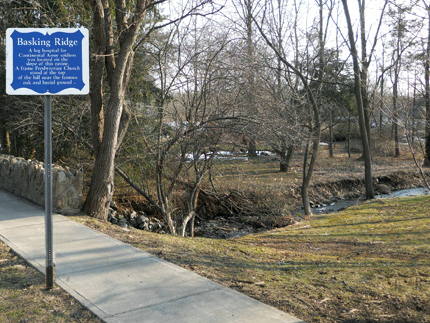
Revolutionary War Hospital Site
North Maple Ave., Near the intersection of East Allen St.
Map / Directions to the Revolutionary War Hospital Site
Map / Directions to all Basking Ridge Revolutionary War Sites
This sign marks the site of a log building which was used as a hospital for American soldiers while the army was encamped in Morristown during the second Morristown winter encampment, in the winter of 1779-1780.
The hospital was located on the property of a man named John Morton. His daughter, Eliza Susan Morton Quincy, who was a child during the Revolutionary War, recorded the following about the hospital in her memoirs which were written in 1821. Note that where she write's "Mr. Morton," she is referring to her father. [7]
"Baskinridge [sic] was in a retired, pleasant situation, enclosed by some high land called 'the Long Hills.' It was a secure place from the British, and at times in the centre of the American Army. The head-quarters of Washington were at Morristown, only seven miles distant. The hospital was located on Mr. Morton's estate. It was long, low log building, situated on a rising ground in a meadow: a brook ran in front of it, and supplied the inmates with water cooking and washing. Dr. Tilton, the director of the medical department with Dr. Stevenson, Dr Coventry, and other physicians, had rooms in my father's house; and a small school-house was converted into an apothecary's shop. This arrangement continued more than two years, and the society of these gentlemen was very agreeable."
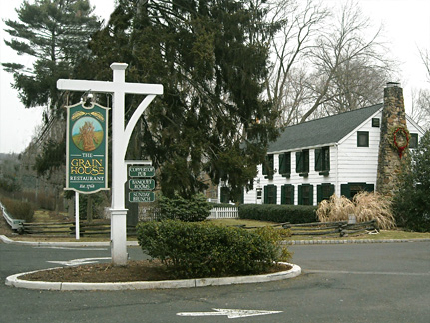
The Grain House
225 Rte. 202
Map / Directions to the Grain House
Map / Directions to all Basking Ridge Revolutionary War Sites
The building which now houses the Grain House restaurant has a long and interesting history. The building was originally located on land across Route 202. In 1768, Samuel Lewis of Basking Ridge built a wooden grist mill (a mill which grinds grain into flour) there, as well as a barn where the grain was stored. The grist mill was water-powered by the Passaic River, which runs through the area. A bridge over the River on Route 202 is next to the restaurant.
Samuel Lewis' grandson, Richard Southard, bought the property in 1777. During the army's difficult second Morristown winter encampment in 1779-1780, Washington's troops were desperate for food. Grain, which was stored in the barn and ground at the mill, supplied some flour to the troops.
In 1929 the property was purchased by a restaurateur, William Childs. The barn was moved in 1930 across Route 202 to its current location. The building was restored and converted into the Grain House restaurant. The area of the barn where grain had been stored is now known as the Grain Room in the restaurant.
The original grist mill was replaced in 1842 with a larger stone mill. It was built by Southard's son-in-law, Ferdinand Van Dorn, who had purchased the property, and is known as Van Dorn Mill. The 1842 stone mill building still stands; it is located on Childs Street, just off Route 202, and is currently used by Innovative Educational Programs. [8]
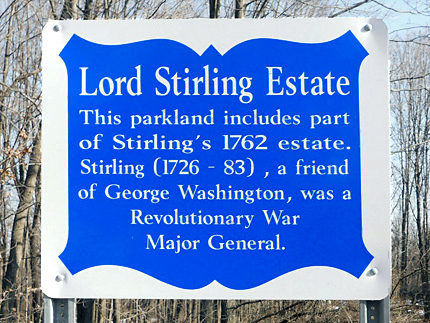
Lord Stirling Estate Site / Lord Stirling Park
Sign is located at the corner of Lord Stirling Rd. & South Maple Ave.
Entrance to Lord Stirling Park
one mile east of here on Lord Stirling Rd.
Map / Directions to the Lord Stirling Estate site
Map / Directions to all Basking Ridge Revolutionary War Sites
Lord Stirling, whose birth name was William Alexander, was born in New York City in 1726. He later moved to Basking Ridge. Stirling began his Revolutionary War service as a colonel in the Somerset County Militia. He was later appointed Brigadier General and then Major General in the Continental Army. Lord Stirling was a close friend of George Washington, and one of his most trusted Generals.
Stirling built a manor house in Basking Ridge in 1762. Part of his property is now Lord Stirling Park, a 950-acre park which includes the Somerset County Environmental Education Center.
The area of the park where Stirling's manor house was located is in an area of the park which is usually closed to the public. The area is open to the public once a year as part of the annual 1770's Festival. A Messenger-Gazette article about the 2014 1770's Festival can be read here. [9]
During the Revolutionary War, Lord Stirling took part in some important events in New Jersey which have historic sites associated with them: [10]
• November 1776 - A small monument in Passaic pays tribute to Lord Stirling at the site of a bridge crossing
• Christmas 1776 - Lord Stirling was part of the famous Crossing of the Delaware River
• December 26, 1776 - Fought at the Battle of Trenton
• June 26, 1777- Fought at the Battle of the Short Hills
• June 28, 1778 - Fought at the Battle of Monmouth
• Winter 1778-1779 - Headquartered at the Van Horne House in Bridgewater during the Second Middlebrook encampment
Stirling died January 15, 1783, just months before the Treaty of Paris officially ended the Revolutionary War. He is buried in Manhattan in Trinity Church Cemetery, the same cemetery where Alexander Hamilton is buried.
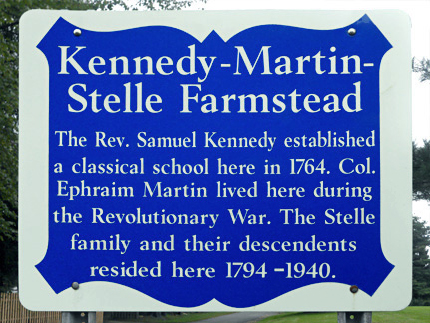
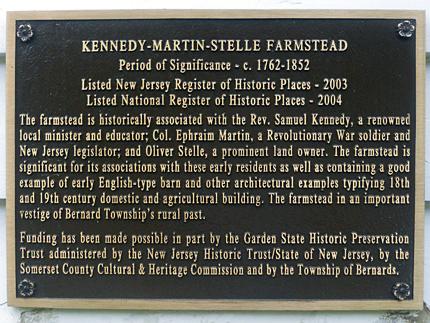
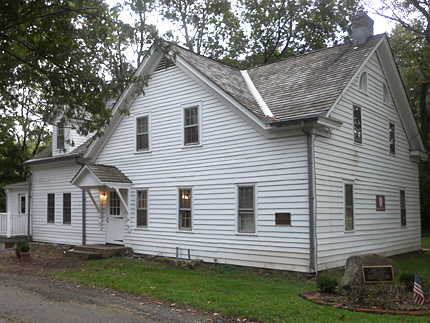
Kennedy-Martin-Stelle Farmstead
450 King George Rd.
Map / Directions to the Kennedy-Martin-Stelle Farmstead
Map / Directions to all Basking Ridge Revolutionary War Sites
This farmhouse was the home of Colonel Ephraim Martin from about 1778 to 1795. He purchased this property from the previous owner, Reverend Samuel Kennedy.
Martin served as a colonel in the Second Regiment, Sussex County Militia, and then as colonel of the Fourth Battalion, New Jersey Line, of the Continental Army. He resigned from the army in 1779 and entered politics. He was elected to the state legislature, representing Somerset County. He continued to serve in the legislature until his death in 1806.
In 1789, Martin served on a committee which recommended that the legislature should ratify the Bill of Rights, the first ten amendments to the Constitution. The legislature did ratify the amendments on November 20, 1789, becoming the first State to do so. [11]
The property is now the home of Farmstead Arts, "a center for fine, performing and practical arts in Basking Ridge." See the Farmstead Arts website for more information about the history of the property, as well as upcoming events.
1. ^ Dorothy Loa McFadden, The Presbyterian Church: A History, 1717 - 1989 - Part 1 (Basking Ridge Presbyterian Church, 1961) Pages 3, 4, 7, 10, and 17
Available to be read as a PDF on the Basking Ridge Presbyterian Church website here.
• The State of New Jersey Historic Sign in front of the church simply states that the original log church was built "before 1731."
McFadden gives details to put the date more specifically at around 1717. On page 4 she writes, "According to old records concerning the Presbyterian Church in Whippany which was organized in 1718, the little log meeting house in which our Basking Ridge congregation first worshipped was erected a year or two earlier – which places the date at about 1717."2. ^ Names from a plaque in the cemetery, presented by the Basking Ridge Chapter of the Daughters of the American Revolution, February 22, 1974
3. ^ Dorothy Loa McFadden, The Presbyterian Church: A History, 1717 - 1989 - Part 1 (Basking Ridge Presbyterian Church, 1961) p.34
Available to be read as a PDF on the Basking Ridge Presbyterian Church website here.
▸ McFadden described the tree as "97 feet high, with a spread of 156 feet and a circumference of 18 feet." She was writing in 1961, so the numbers would be slightly different now.4. ^ Washington's "I have so frequently mentioned our situation..." quote is from his letter to General Lee on December 14, 1776. The full letter appears in:
George Washington; Worthington Chauncey Ford, Editor, The Writings of George Washington Volume 5 (New York and London: G.P. Putnam's Sons / The Knickerbocker Press, 1890) p. 96
Available to be read at Google Books here
▸ It is interesting to note that since the letter is dated December 14, it was written after Lee had already been captured, but before word of the capture had reached General Washington.• For more about the tensions between Washington and Lee prior to Lee's capture, see:
Ron Chernow, Washington: A Life (New York: The Penguin Group, 2010) Pages 265-2685. ^ General James Wilkinson, Memoirs of my Own Times, Volume 1 (Philadelphia: Abraham Small, 1816) p.105 - 106
Available to be read at Google Books here6. ^This marker was erected by the Daughters of the American Revolution.
• For more details and accompanying source notes about the Battle of Princeton and the 1777 Morristown encampment, see the Princeton and Morristown pages of this website.
7. ^ Eliza Susan Morton Quincy, Memoir of the life of Eliza S.M. Quincy (Boston: J. Wilson and Son, 1861) page 19
Available to be read at Google Books here
▸ Quincy wrote in 1821, when she was the wife of Josiah Quincy, would later become Mayor of Boston. In a prefatory note, she explains, "In compliance with the request of my children, I have written from memory and from the recollections of my mother, now residing in our family and eighty-three years of age, the following narrative of some events in the lives of my maternal ancestors and of my own early life."
Eliza was born in 1774, and so she would have been very young when the hospital was here, so presumably her mother's memories helped to supply her with some of the details about the hospital.
▸ A portrait of Eliza, painted in 1809 by Gilbert Stuart, is in the collection of the Museum of Milwaukee. A photo of the painting can be seen on the Museum of Milwaukee website.
• Gilbert Stuart is best known for his paintings of George Washington, including the one that is the basis for the image on the One Dollar Bill8. ^ Information was drawn primarily from The History of the Grain House PDF on the restaurant's website. The document is credited as "Written in conjunction and with sincere appreciation of the Somerset Hills Historical Society."
• For more details and accompanying source about the harsh conditions of the 1779-1780 Morristown winter encampment, Morristown page of this website.
9. ^ Information about the park, the acreage, and the site of the manor house was drawn from the Welcome to the Environmental Education Center at Lord Stirling Park brochure, produced by the Somerset County Park Commission
10. ^ For more information and accompanying source notes about the events mentioned, see the pages linked to in the text.
11. ^ Information drawn from:
• Historic Markers at the Kennedy-Martin-Stelle Farmstead
• Farmstead Arts at the Kennedy Martin Stelle Farmstead website - History section
• William S. Stryker, Official Register of the Officers and Men of New Jersey in the Revolutionary War (Trenton: Wm. T. Nicholson & Co., 1872) Pages 37, 347, and 353
Available to be read at Google Books here
The ultimate field guide to New Jersey's Revolutionary War historic sites!
United States Semiquincentennial • America 250th anniversary
Basking Ridge New Jersey Revolutionary War Sites • Basking Ridge New Jersey Historic Sites
Basking Ridge Presbyterian Church • Washington Route Marker • Revolutionary War Hospital Site • Widow White's Tavern
French Soldier Encampment • Grain House • Kennedy-Martin-Stelle Farmstead
Website Researched, Written, Photographed and Designed by Al Frazza
This website, its text and photographs are © 2009 - 2026 AL Frazza. All rights reserved.