

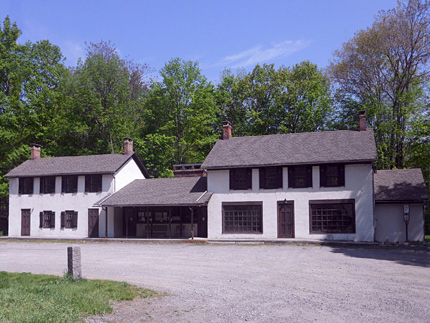
The Visitors Center and Museum
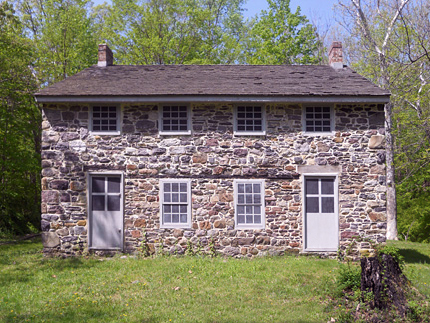
The Stone Double House - Built before the Revolutionary War
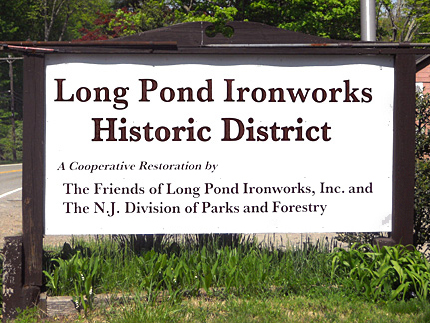
Long Pond Ironworks Historic District
1376 Greenwood Lake Tpke.
Map / Directions to Long Pond Ironworks Historic District
For more information, see the Friends of Long Pond Ironworks website.
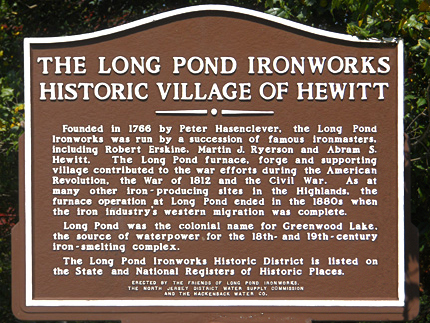
Long Pond Ironworks was founded in 1766 by Peter Hasenclever, a man who also ran ironworks at Ringwood and Charlotteburg. By the beginning of the Revolutionary War, all of these ironworks were run by Robert Erskine. Erskine played an important role during the war, serving as the first Geographer and Surveyor-General of the Continental (American) Army. In that role, he created over 200 maps for General George Washington and the Continental Army.
During the Revolutionary War, Long Pond Ironworks produced equipment and tools for the Continental Army. The furnace in use at that time stood twenty-five feet high and was capable of producing twenty-five tons of iron a week. A very small portion of that original furnace exists in ruins here. The remains of a later furnace, built during the Civil War, is also here, in substantially better condition than the earlier one. Long Pond Ironworks ceased production in 1882.
In addition to the ruins of furnaces from the Revolutionary War and Civil War eras, there are a number of other buildings and structures on the property. The Stone Double House shown above dates to pre-Revolutionary times; it is the only surviving building which was here at the time of the Revolutionary War.
There are hiking trails which wind through the property. Historical markers along the trails explain the history of Long Pond and the structures which are still visible here. Trail map pamphlets are available at the Visitors Center.
The Visitors Center and Museum displays artifacts from the history of Long Pond Ironworks, although most of the items date to periods later than the Revolutionary War. [1]
1. ^ Information for this entry was drawn from:
• Signs and markers at Long Pond Ironworks Historic District
• Friends of Long Pond Ironworks website
• Telephone interview conducted on October 5, 2016 with Joe Rosolen, Vice President of the Friends of Long Pond Ironworks.
I would like to thank Joe for taking the time to speak with me and answer my questions.
The ultimate field guide to New Jersey's Revolutionary War historic sites!
West Milford New Jersey Revolutionary War Sites • West Milford New Jersey Historic Sites
Website Researched, Written, Photographed and Designed by Al Frazza
This website, its text and photographs are © 2009 - 2024 AL Frazza. All rights reserved.