

Hamburg Baptist Church Cemetery
15 Route 23 North
Map / Directions to the Hamburg Baptist Church Cemetery
Map / Directions to the all Hamburg Revolutionary War Sites
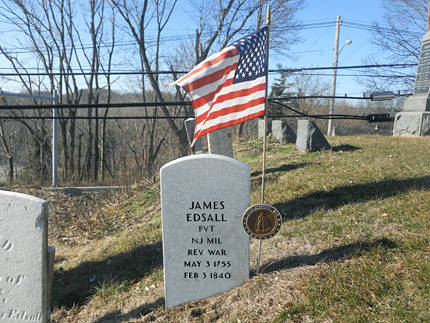
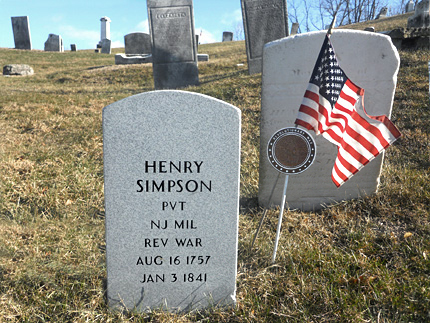
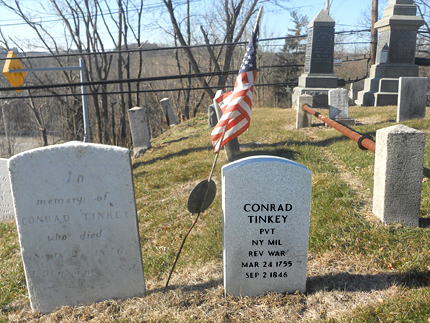
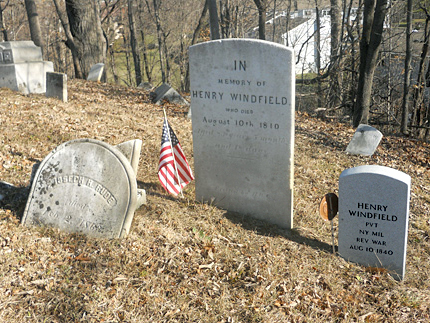
There are four known Revolutionary War soldiers buried here: [1]
James Edsall
(May 3, 1755 - February 3, 1840)
Private, New Jersey Militia
Henry Simpson
(August 16, 1757 - January 3, 1841)
Private, New Jersey Militia
Conrad Tinkey
(March 24, 1755 - September 2, 1846)
Private, New York Militia
Henry Windfield
(Died August 10, 1840)
Private, New York Militia
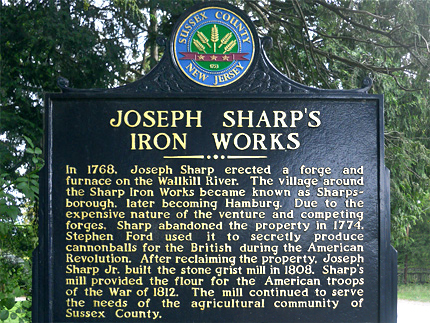
Joseph Sharp's Iron Works
Gingerbread Castle Rd.
Off of Rte. 23
Map / Directions to Joseph Sharp's Iron Works
Map / Directions to the all Hamburg Revolutionary War Sites
This historic marker on Gingerbread Castle Rd. marks the area on the Wallkill River where Joseph Sharp, Sr. erected the Sharp Iron Works forge and furnace in 1768. In 1774, Sharp abandoned the property for financial reasons, and left this area to return to his original home of Salem County, where he died in 1776.
At the time of the Revolutionary War, the iron works that Joseph Sharp, Sr. had abandoned were utilized by a man named Stephen Ford who lived nearby. Ford had been born in England and was a Tory (British sympathizer) during the war. Ford used the iron works to produce cannonballs for the British in secret, for which he is believed to have been well paid.
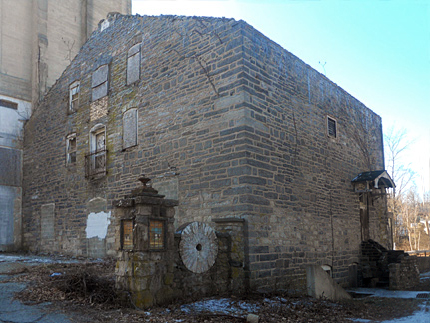
After the Revolutionary War, Joseph Sharp, Sr.'s son, Joseph Sharp, Jr., reclaimed the property. In 1808, Joseph Jr. built a stone grist mill here, which would go on to provide flour for the American army in the War of 1812. After a fire in the 1830's, the mill was rebuilt. The mill, which had been renamed Wheatsworth Mill, was used by several businesses, along with the large concrete buildings that had been built adjacent to it, until the 1980's when it was still in use as office space.
Nothing remains of the original Revolutionary War era iron works. However, the rebuilt 1808 stone gristmill still stands across the street from this sign. It is abandoned and in poor condition. (Shown right.) [2]
1. ^ Names, military ranks, and dates were drawn from gravestones in the cemetery.
2. ^ Information for this entry was drawn from several sources, including:
• The historic sign at the site (erected by Sussex County New Jersey in 2003.)
• Alanson Austin Haines, Hardyston Memorial - A History of the Township and the North Presbyterian Church (Newton NJ, New Jersey Herald Print 1888) p.84 Available to be read at Google Books here
Haines' account includes details which I chose not to include in the entry above because they sound unreliable to me. Like many history books from the time, this book doesn't list its own sources, and the account sounds a little too fanciful. (To me anyway).
For those interested, here is the text from Haines book that I am referring to:
" [Stephen Ford's] men often performed their work at night, and the children and females of the family carried food for the workmen from the house to the forge after dark. He received considerable sums of English gold which he secreted in small bags let down in the partition walls between the plastering. He had sheet iron shutters made at the forge for the windows of his house. This was reputed to be a place of retreat for the more open Tories and free booters when they were closely pursued. He seems to have been on good terms with his neighbors, even the patriotic ones, and kept quiet in the later years of the war, escaping arrest although under surveillance."
• The Pennsylvania Magazine of History and Biography, Vol XX (Philadelphia: The Historical Society of Pennsylvania, 1896) p. 134
Available to be read at the Internet Archive here.
• Marion E. Wood, All About Hamburg (McAfee, NJ: Country Cousin, 1999) pages 4-7 and 243-244The ultimate field guide to New Jersey's Revolutionary War historic sites!
Hamburg New Jersey Revolutionary War Sites • Hamburg New Jersey Historic Sites
Joseph Sharp's Iron WorksWebsite Researched, Written, Photographed and Designed by Al Frazza
This website, its text and photographs are © 2009 - 2024 AL Frazza. All rights reserved.